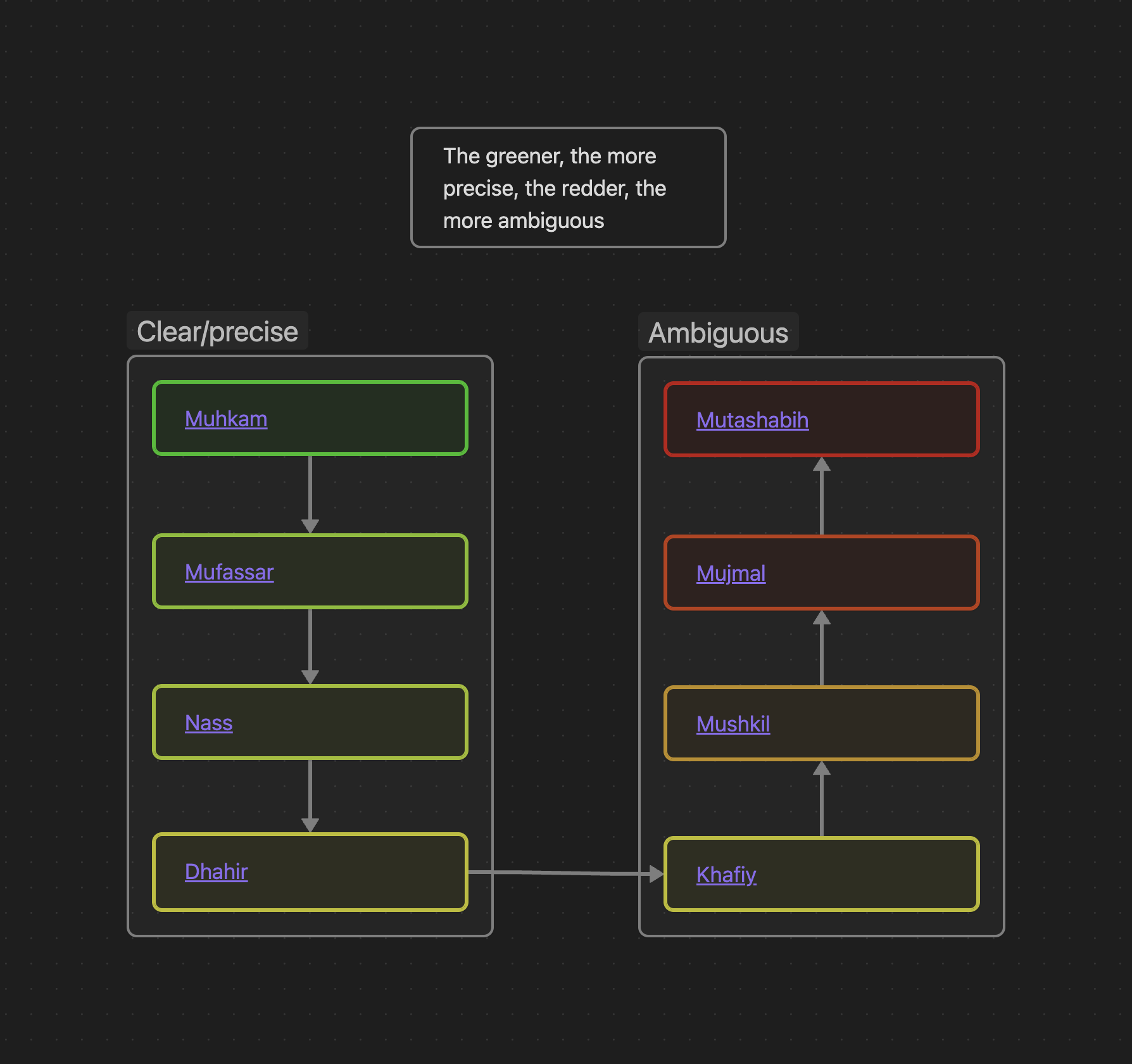
Definition
The way we defined Nass was that there was an evidence to explain the word.
In this, there was an ambiguity within the word itself. i.e. the mere utterance of the word does not give sufficient understanding.
Ishkaal can take place because of 2 reasons:
- because the word is so deep and the word is so ancient that has developed over history that in order to understand it, it requires elaboration
- The sentence has multiple meanings and therefore we need to filter the meanings
Example
The ayah that states the man in the state of junub, then he should cleanse themselves (fat-tahharu) to give justice to the meaning, you would have to be well cleaned i.e. taking a ghusl.
Example 2
The ayah regarding menses, that it is dirt and stay away from your women until they become clean (yathurn).
A principle of nahw is the greater the word, the greater the meaning. So for men, it was to do ghusl. For women, it was just to become clean.
When a woman reaches the maximum time for menses (10 days), she does not need to take ghusl and can become intimate with her husband. Whereas for men, there is no limit, and you must take a ghusl before any ibadaat.
The ishkal is that the same root words are used, however, the words were in different templates and therefore ijtihaad had to take place.